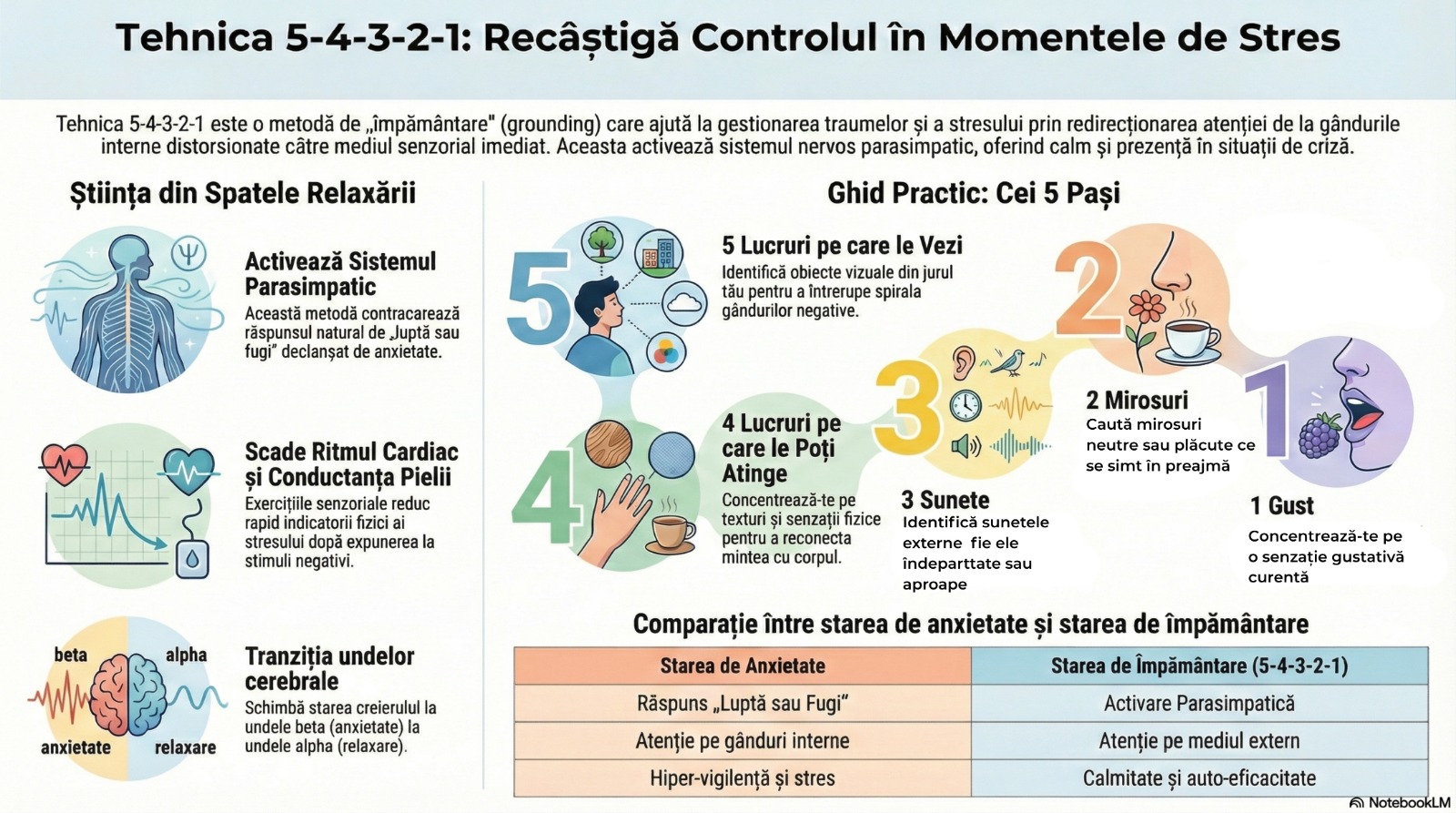
Anxiety is probably the most common challenge for which people seek psychological support in our modern world. If you suffer from anxiety, a psychologist in Iasi can help you understand, decode, and effectively manage these overwhelming feelings. Although often perceived as an "enemy" that blocks or paralyzes us, it essentially has a vital biological protective role. Your body is not attacking you; it is trying to warn you of danger, even if that danger is often imaginary, projected into the future, or related to unresolved past trauma.
How Do You Recognize Anxiety?
Symptoms of anxiety are diverse and can be extremely frightening, ranging from intense physical manifestations to intrusive thoughts:
- Physical Sensations: Palpitations, shallow breathing (hyperventilation), a feeling of a lump in the throat, dizziness, trembling, or excessive sweating.
- Catastrophic Thoughts: "What if something bad happens?", "What if I embarrass myself?", "What if I can't handle it?". The mind constantly creates "what-if" scenarios.
- Avoidance Behavior: A constant need for reassurance from others or avoiding places and situations that cause discomfort.
The Biological Mechanism: Fight, Flight, or Freeze
When you feel anxious, the amygdala (the brain's alarm center) takes control and activates the sympathetic nervous system. This "fight or flight" reaction was essential for our ancestors, but in the modern world, it often activates due to job stress, relational conflicts, or thoughts about the future. The problem arises when this system remains stuck in the "on" position.
Steps Toward Management and Healing
In the process of individual psychotherapy, we work on several levels to reduce the impact of anxiety on your life. As a psychologist for anxiety in Iasi, we don't seek to eliminate it completely – because fear is a fundamental human emotion – but to decrease its intensity to a manageable level.
- Befriending Sensations: We use grounding techniques to learn how to observe what is happening in your body without falling into secondary panic.
- Challenging Thoughts: We learn to critically analyze the "stories" anxiety tells. Are these fears based on actual facts or on distorted interpretations?
- Gradual Exposure: We return to the activities you've started avoiding, but we do it at a safe and controlled pace.
Anxiety feeds on avoidance. The more you run from it, the bigger and more threatening it becomes. By facing it in a protected and professional therapeutic setting, you will discover that you have the resources necessary to cope and regain your freedom to live the life you desire.