Have you ever felt overwhelmed, with your mind trapped in a whirlwind of anxious thoughts from which escape seems impossible? In those moments, a complex solution is the last thing you need. This is where the 5-4-3-2-1 grounding technique comes in, a surprisingly simple yet powerful tool. But behind its simplicity lie precise psychological and biological mechanisms. If you frequently face these states, you know how important it is to have quick strategies at hand, as well as long-term support through individual psychotherapy. This article will reveal four unexpected truths about this method, based on research, that demonstrate why it is much more than a simple relaxation exercise.
First Truth: It's Not Just a Distraction, But a Biological "Hack" for Your Nervous System
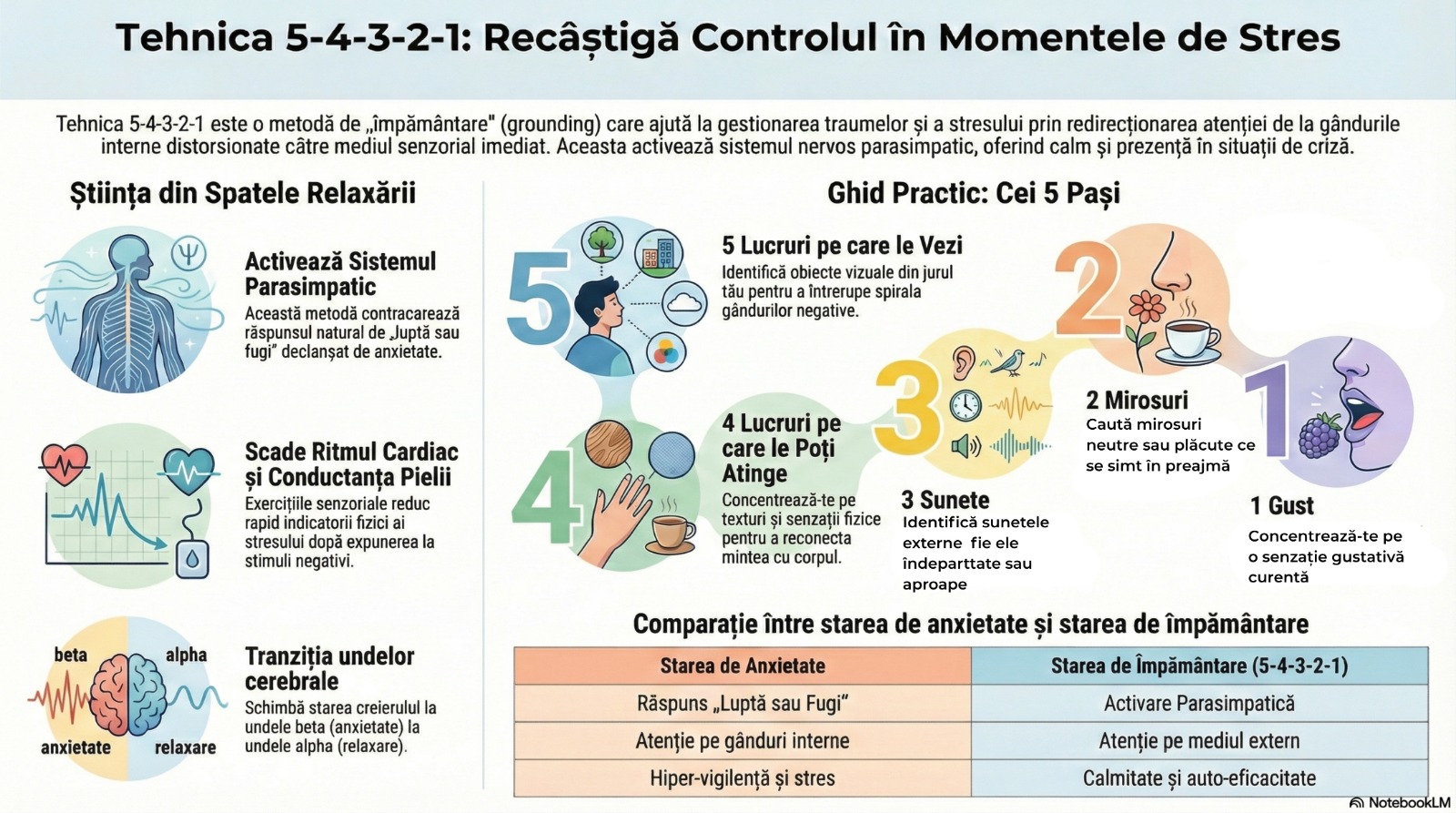
At first glance, the 5-4-3-2-1 technique seems like a simple way to distract your attention. However, its effectiveness is actually an elegant "hack" of our biology. When anxiety sets in, the brain's alarm system (the amygdala) triggers the automatic "fight or flight" response. The technique works as a conscious override of this primal instinct. By using the neocortex – the rational part of the brain – to deliberately focus on the senses, you actively send safety signals to the alarm center, communicating that the danger is not real and present.
This process of focusing on sensory stimuli activates the parasympathetic nervous system, responsible for relaxation. Research indicates measurable physiological benefits: faster reductions in heart rate and skin conductance (a scientific indicator of stress response). Moreover, the technique can change brain activity, helping the brain transition from a state of beta waves, associated with anxious vigilance, to a state of alpha waves, characteristic of calm and conscious relaxation.
Second Truth: It Was Tested in Extreme Conditions, on Crisis Hotlines During the Pandemic
The power of a self-help technique is confirmed when it works under maximum stress conditions. The 5-4-3-2-1 technique (also known in this context as the 12345 technique) proved its value during the COVID-19 pandemic, when it became an essential tool for emergency hotline operators. They acted as a vital communication bridge between government and the public, facing an unprecedented volume of calls from people in acute emotional distress, while also managing their own intense occupational stress.
The method served a dual purpose: it helped operators maintain their calm and focus during difficult interactions and, at the same time, provided them with a structured and easy-to-transmit tool to help callers manage their own overwhelming anxiety. The fact that it was effective in a crisis context, where emotions reach extreme levels, validates its power as a rapid emotional stabilization tool.
Third Truth: It Works as Training for the "Muscle" of Emotional Regulation
Although the 5-4-3-2-1 technique offers immediate anxiety relief, its benefits extend long-term. Regular practice of this method can be seen as training for the "muscle" of emotional regulation. Each use of the technique creates and consolidates new neural pathways in the brain. With each repetition, you build a cognitive "reflex" for calm, which, over time, becomes faster and more automatic than the anxiety reflex.
Beyond calming a panic attack, this exercise develops a general state of mindfulness, meaning increased awareness of the present. Through practice, you learn to redirect your attention from spirals of negative thoughts to the concrete reality of your surroundings. This ability not only reduces the frequency of anxiety episodes but contributes to a general state of well-being and greater resilience in the face of daily challenges.
Fourth Truth: It's a Professional Tool from Trauma Therapy, Simplified for Everyone
The 5-4-3-2-1 technique is not a recent trend that appeared on social media, but has solid origins in psychological practices for trauma management. It represents a simplified and accessible version of methods used by therapists in trauma-informed care. In a clinical context, grounding techniques are essential for stabilizing clients dealing with intrusive memories, helping them create a sense of safety in their own body and in the present moment.
Therefore, although it looks like an exercise simple enough for a viral video, its foundation lies in serious clinical work to help trauma survivors regain a sense of safety in their own body. This gives it immense credibility and demonstrates that it is not just a trick, but a clinically-grounded strategy, adapted to be used by anyone, anywhere.
What This Technique Consists Of
The process involves consciously identifying the following elements from your surroundings:
- 5 things you can see: Observing visual details around you to stabilize attention
- 4 things you can touch: Focusing on tactile sensations (texture of clothes, nearby objects)
- 3 things you can hear: Identifying external sounds, whether distant or close
- 2 things you can smell: Looking for neutral or pleasant smells in the environment
- 1 thing you can taste: Focusing on a current taste sensation
***
Practical Tips for Maximum Effectiveness
For the exercise to work reflexively in moments of crisis, consider these suggestions:
- Practice during calm times: Like a muscle, this technique becomes more effective through repetition. Don't wait for a panic attack to try it for the first time.
- Say it out loud: When you name objects ("I see a white chair", "I hear a car"), you also activate the speech center, which additionally helps "deactivate" the amygdala.
- Don't rush: The goal is not to finish the list, but to truly connect with each sense. Give yourself 5-10 seconds for each observed element.
Conclusion
From rebalancing the nervous system at a biological level to its validation in the most acute human crises, the 5-4-3-2-1 technique proves to be an emotional regulation strategy with deep clinical roots, disguised as a simple exercise.
Next time you feel anxiety overwhelming you, what from your surroundings will you choose to observe first?
Do you feel that anxiety is controlling your life and relaxation techniques are no longer enough?
You don't have to go through this alone. Schedule an introductory session and let's build together a personalized plan for your peace of mind.